If you're applying for jobs in Egypt, Saudi Arabia or elsewhere in the Arab world, you'll soon face a practical question: should you send a CV in Arabic, a CV in English, or both? There's no single rule for the whole region. The good news is that the job ad usually tells you what the employer wants, if you know where to look. This guide shows you how to decide, how to write a CV in Arabic that reads naturally, and how to keep two language versions in sync without doubling your work.
The short answer: follow the job ad
The most reliable signal is the language the employer used to write the ad. An ad in Arabic suggests an Arabic CV will be welcome, and an ad in English suggests the same for English. On top of that, check:
- The application instructions. Some ads say directly which language or format they want. If they do, follow them exactly.
- The application form. If you apply through a portal, look at the language of the form and the fields you're asked to fill in.
- The company's careers page and website. If the company publishes mainly in one language, that's a useful hint.
- The daily language of the role. A job where you'll write reports, emails or customer messages in one language is a strong reason to show that language on your CV.
When the signals conflict, or the ad is bilingual, send the version that matches the language of the job's daily work, or prepare both (more on that below). If you're still unsure, it's perfectly reasonable to ask the recruiter which they prefer.
When a CV in Arabic is the better choice
An Arabic CV tends to make sense when:
- The job ad is written in Arabic and doesn't ask for anything else.
- Arabic is the core of the job. Think Arabic content writing, translation into Arabic, Arabic-language customer service, or teaching Arabic subjects.
- You're handing your CV to someone in person, such as the owner of a local business who you know reads Arabic comfortably.
- The employer's own forms and communication are in Arabic.
Expectations differ between employers in the same country and even between departments in the same company, so treat these as starting points, not rules. Local companies and public-sector employers may lean towards Arabic, but always confirm with the ad itself.
When an English CV is the better choice
An English CV tends to make sense when:
- The job ad is in English, even if the company is local.
- You'll use English at work, for example with international clients, head offices abroad or English-language systems.
- You're applying through an English-language portal or to a company that publishes its careers pages in English.
- You're applying to jobs outside the Arab world.
An English CV also shows your English level at a glance, so it has to be accurate. A CV full of grammar slips undermines a claim of "fluent English."
When to prepare both versions
Keeping two versions ready is worth the effort if:
- You're applying to a mix of local and international employers.
- You attend job fairs, where you don't know in advance who you'll meet.
- The ad is bilingual, or a recruiter asks for one version after receiving the other.
Send only the version that was asked for. If the ad doesn't specify, send the one that matches its language and mention that the other version is available on request. Attaching both by default makes the reader choose.
How to write a CV in Arabic that reads naturally
Writing a CV in Arabic isn't just translating your English one. These points make the difference between a CV that reads like an Arabic document and one that reads like a translation.
Use simple Modern Standard Arabic
Write in clear, simple Modern Standard Arabic, not dialect and not overly literary Arabic. "أعددت تقارير المبيعات الشهرية" reads well. Dialect phrases and long, ornate sentences don't belong in a CV.
Translate meaning, not words
The biggest trap when you turn an English CV into Arabic is translating word for word. Compare:
| English | Too literal | Natural Arabic |
|---|---|---|
| Owned the month-end close | امتلكت الإقفال الشهري | توليت إقفال الحسابات الشهرية |
| Hands-on experience with SAP | خبرة الأيدي على SAP | خبرة عملية في استخدام SAP |
| Team player | لاعب فريق | أعمل بفاعلية ضمن فريق |
| Drove growth in renewals | قدت النمو في التجديدات | رفعت نسبة تجديد العقود |
Be careful with job titles
Some titles change meaning when translated word for word. Account Manager in a sales team, translated literally, can be read as an accounting role. Use the Arabic title your employer used, if there was one. If not, translate the meaning, for example مدير علاقات العملاء, and keep the original English title in brackets when it helps.
Keep tool and certificate names as they are
Write Excel, SAP, Power BI, CMA or PMP in their original form. Readers search for these names, and transliterating them into Arabic letters makes them harder to recognize.
Pick one digit style and one date format
Both Western digits (2024) and Arabic-Indic digits (٢٠٢٤) are used in Arabic writing. Choose one and use it everywhere. Western digits are often easier when your CV mixes English tool names, phone numbers and email addresses. Do the same with dates: one format, month and year for every role.
Check the right-to-left layout
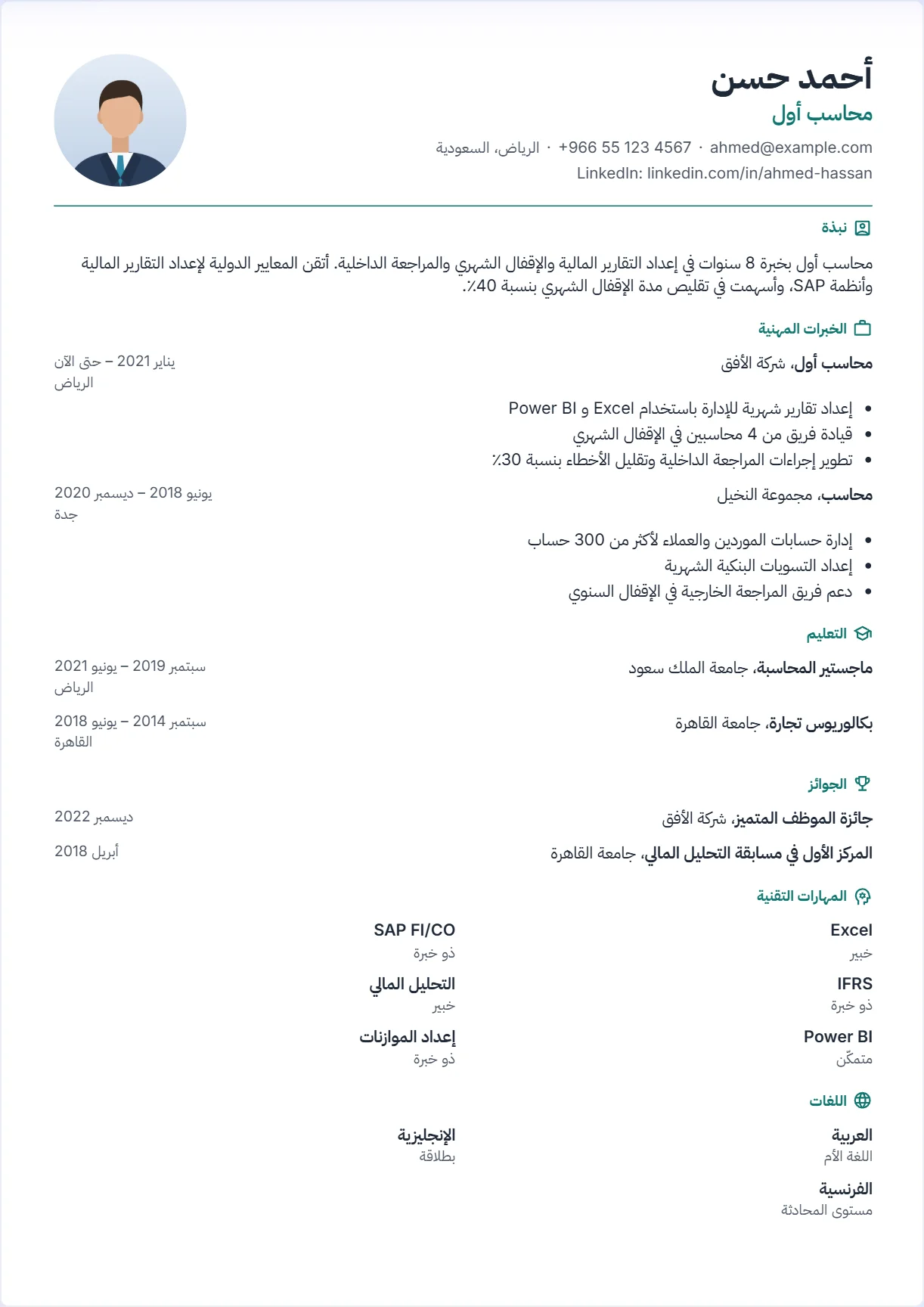
In an Arabic CV the whole page should flow from right to left: headings, bullets, dates and sidebars. Mixed lines, such as a sentence that contains "Power BI" or a phone number with a "+" sign, are where problems show up. Always open the final PDF and check those lines, plus any brackets and punctuation.
Keep both versions in sync
Two versions of your CV should tell exactly the same story. Before you send either one, check:
- The same facts. Job titles, employers, dates and numbers match in both versions.
- The same name spelling. In the English version, spell your name the way it appears on your passport and LinkedIn profile, and use that spelling everywhere.
- An honest Languages section. For example, Arabic: Native and English: Fluent (IELTS 7.0). Add a test score only if you have one.
- Clear file names. Omar-Hassan-CV-EN.pdf and Omar-Hassan-CV-AR.pdf tell the reader at once which is which.
- Updates in both. When you add a new job or certificate, update both versions the same day.
An example: one candidate, two applications
Omar Hassan is an accountant in Alexandria. In the same week he applies to two jobs:
- Al Waha Trading has posted an Arabic ad asking for CVs by email. Omar sends his Arabic CV, with a summary that highlights branch accounts and VAT returns, and writes a short email in Arabic.
- Northgate Logistics has an English ad and an online application portal. Omar uploads his English CV, with the same experience but a summary aimed at financial reporting, and pastes the plain-text version into the portal's form fields.
Both CVs contain the same facts. Only the language, the summary and the order of a few bullets change. If an application also asks for a cover letter, the same rule applies: write it in the language of the ad. Our cover letter guide shows how to structure one.
Building your CV in English or Arabic with DraftPik
The DraftPik resume generator supports CVs in English and in Arabic, and Arabic CVs use a right-to-left layout. A new CV starts in the language of the site you're on, and the Design language switch at the top of the Customize tab changes it at any time without touching what you've typed. The same resume templates work for both, and the live preview shows A4 or US Letter pages with automatic page breaks.
A few practical points if you want two versions:
- On the Free plan you keep one saved CV, so finish one version and download its PDF before you work on the other. A free account gives you clean PDFs without a watermark, up to 10 downloads a day.
- On Pro you can keep an Arabic and an English CV side by side as separate documents, with no download limit.
- For online forms, export a plain-text version of your CV and paste from it.
DraftPik doesn't translate your CV for you. You write each version yourself, which is also the best way to make sure it reads naturally. Before you start, our step-by-step guide on how to make a CV covers the content of each section, and our list of common CV mistakes helps you check the result in either language.
FAQ
Is a CV in Arabic less professional than one in English?
No. A well-written Arabic CV is just as professional as an English one. What matters is whether it matches what the employer asked for and whether it's clear, accurate and free of mistakes.
Can I write one bilingual CV with Arabic and English side by side?
You can, but it usually doubles the length and makes the page harder to scan. Two separate, clean versions are easier to read, and you can send whichever one the employer asked for.
Do applicant tracking systems read Arabic CVs?
Support for Arabic varies between systems. If you apply through a portal, follow its instructions. If the portal is in English and doesn't mention Arabic, an English CV is the safer default.
Should I translate my name in the English CV?
Don't translate it, transliterate it, using the same Latin spelling as your passport. Consistent spelling across your CV, email address and LinkedIn profile makes you easier to find.
Ready to write your next version? Open the resume generator, pick a template, and build your CV in the language the job asks for. Creating your CV and downloading a clean PDF with a free account is free.