"Tell me about yourself" is usually the first real question in a job interview, and it sets the tone for everything after it. It sounds casual, but it isn't an invitation to share your life story. It's a chance to give a short, prepared pitch that connects who you are to the job in front of you. This guide gives you a simple structure, a preparation routine and sample answers for a fresh graduate, a career changer and an experienced professional.
What the interviewer really wants to hear
When an interviewer asks you to tell them about yourself, they rarely care about your hometown or your childhood. They want quick answers to a few practical questions:
- Who are you professionally? Your current role, field or level.
- Why are you here? What draws you to this role and this company.
- Can you communicate clearly? Whether you can give an organized answer without rambling.
- What should we talk about next? Your answer often decides which parts of your CV they ask about.
That last point matters most. A good answer works like a menu: you mention two or three strengths, and the interviewer picks one to explore. Prepare well, and the rest of the interview happens on topics you're ready for.
A simple structure: present, past, future
The easiest way to organize your answer is in three short parts.
1. Present: where you are now
Start with your current role or situation in one or two sentences: your title, your field and one thing you do well.
"I'm a customer support team lead at a software company, where I manage a team of six and handle our most complex client accounts."
2. Past: how you got here
Pick one or two experiences that explain your strengths, ideally with a concrete result. This is where your best CV bullet points become spoken sentences.
"Before that, I spent three years as a support agent and wrote the internal help guide our team still uses to train new hires."
3. Future: why this role
Finish by connecting your story to the job. Say what you want next and why this position fits. This bridge turns a biography into a reason to hire you.
"I'm now looking to move into customer success, where I can work with clients before problems start, which is why this role caught my attention."
You can also start with the past and move forward in time. What matters is that your last sentence points at the job you're interviewing for.
How long should your answer be?
Aim for about one to two minutes when spoken. That's enough for a clear story and short enough to keep the interviewer engaged. Read your draft aloud with a timer, and if it runs long, cut details instead of speaking faster.
A quick test: one current role, one or two highlights from the past and one sentence about the future is plenty. If you have more than three main points, trim.
How to prepare your answer step by step
Don't memorize a script word for word, because it can sound stiff. Prepare the content carefully instead:
- Reread the job ad. Underline the two or three skills that appear most often. Your answer should touch on them.
- Open your CV next to it. The interviewer probably has your CV in front of them, so your answer should match it.
- Choose your highlights. Pick one or two achievements with something concrete attached: a number, a scale or a clear outcome.
- Write a rough draft using present, past and future. Keep sentences short, because short sentences are easier to say.
- Say it out loud several times. Change any phrase that feels awkward when spoken.
- Reduce it to keywords, such as team lead, help guide, customer success. This keeps your answer natural instead of recited.
- Adapt it for each interview. Change the highlights and the closing to fit each company.
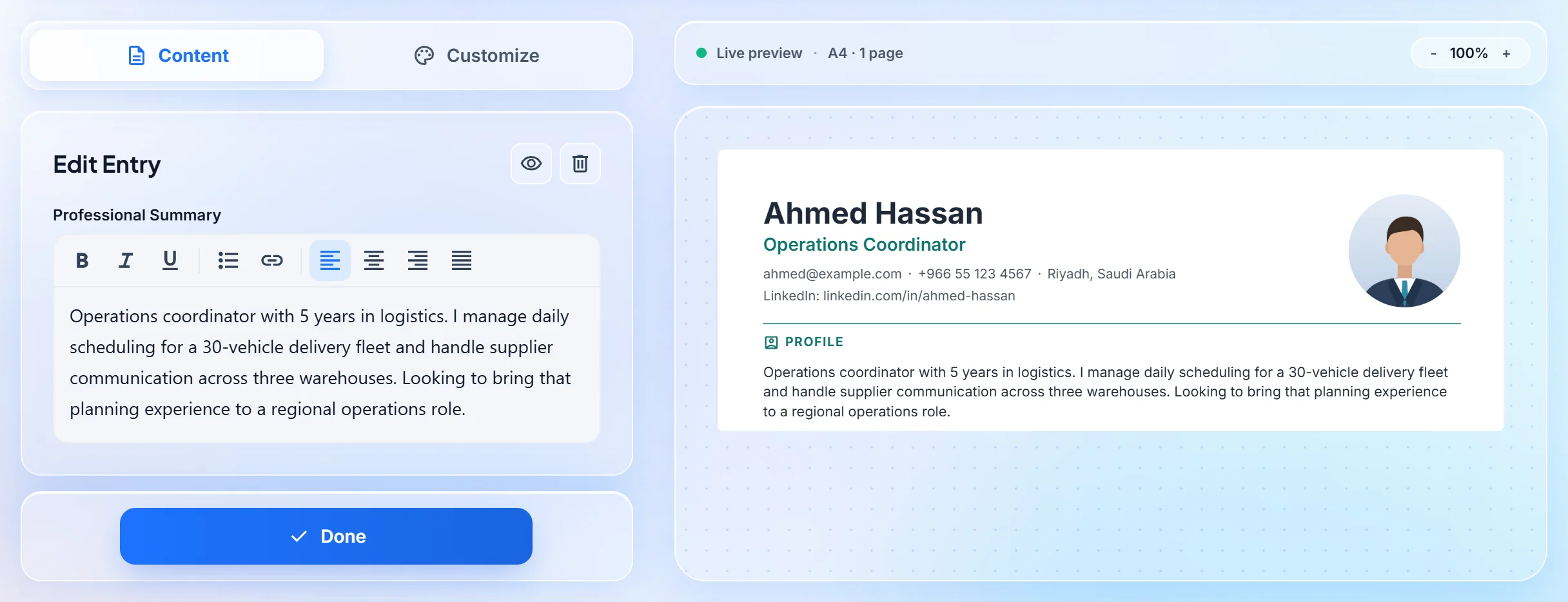
If your CV is out of date, update it first. Writing a strong CV summary is almost the same exercise as preparing this answer, and doing one makes the other easier.
Tell me about yourself: sample answers
The answers below use made-up names and details. Borrow the structure and length, then replace everything with your own real experience.
Sample answer for a fresh graduate
Without much work experience, lean on your studies, projects, internships and any responsibility you've taken on.
"I recently graduated with a degree in business administration, with a focus on marketing. In my final year, I led a four-person team on a graduation project where we built a social media plan for a local bakery, and the owner used part of it for her launch campaign. I also did a two-month summer internship at a digital agency, preparing weekly performance reports for clients. That's where I realized I enjoy the analytical side of marketing as much as the creative side. I'm now looking for a junior marketing role where I can build both, and I was glad to see that this position includes campaign reporting."
Why it works: It opens with the degree, gives one project with a real outcome, uses the internship as evidence and ends with a clear link to the job.
Sample answer for a career changer
Explain the switch briefly and show which skills carry over. Don't apologize for the change. Present it as a deliberate decision.
"I spent six years as a high school math teacher, and the part of the job I enjoyed most was analyzing student results to see where they were struggling. I built spreadsheets to track progress across my classes, and other teachers started asking me to set them up for them too. That pushed me to study data analysis seriously. Over the past year I completed a data analytics certificate and built three portfolio projects, including a dashboard of public transport data. I'm now looking for a junior data analyst role, and what I bring is the ability to explain numbers clearly to people who aren't technical, which I did every day in the classroom."
Why it works: The old job isn't hidden. It's used as proof of relevant skills, the answer shows concrete steps toward the new field, and it ends with a strength specific to this candidate.
Sample answer for an experienced professional
With many years behind you, the challenge is choosing what to leave out. Focus on the level you've reached and the results that matter most for this role.
"I'm an operations manager with about twelve years in logistics, the last five leading a regional warehouse team of around forty people. My focus has been making operations more reliable. For example, I redesigned our picking process, which cut order errors and became the standard for our other sites. Before that I worked in procurement, so I understand the supplier side of the chain too. I'm interested in this role because you're expanding into new regions, and setting up and stabilizing new operations is the work I've enjoyed most."
Why it works: It sums up a long career in one sentence, gives one strong example instead of a full history and ties the experience to the company's current situation.
What to leave out
These topics weaken an otherwise good answer:
- Your full life story. Skip where you grew up and your school days unless they connect directly to the job.
- Personal details such as marital status, age or health. You don't need to volunteer them.
- Complaints about past employers. Even if you left for a good reason, criticism makes you sound like a risk.
- Reading your CV aloud. Give the story and the highlights, not every job title and date.
- Empty clichés like "I'm a hard worker and a perfectionist." Replace each one with an example that shows it.
- Salary and benefits. That conversation comes later.
A hobby can work as a final sentence if it's genuine and adds something, such as organizing a community event, but don't let it take over.
Variations of the same question
The same prepared answer works for most versions of this question with small changes:
- "Walk me through your CV." Follow your career in order, keep it brief and still end with why you're applying.
- "How would you describe yourself?" Pick two or three qualities and back each with a short example.
- "Why should we hire you?" Lead with the future part, then support it with your strongest highlights.
For phone screens, keep a 30-second version ready: your current role, one highlight and what you're looking for. In video interviews, look at the camera when you speak and keep your notes short.
Make your CV and your answer tell the same story
If you mention leading a project, the interviewer should be able to find it on the page. If your CV leads with skills your answer never mentions, one of the two needs updating. Before your next interview, check that:
- Your CV summary and your spoken answer describe you the same way.
- The achievements you plan to mention appear in your experience section.
- The role you're targeting is clear at the top of your CV.
A cover letter can follow the same three-part idea, and our guide on how to make a CV covers building the document itself.
FAQ
Should I memorize my answer?
Memorize the structure and key points, not every word. A fully memorized script tends to sound recited, and if you lose your place it's harder to recover. Practice from short notes until the answer flows.
Can I mention personal interests?
Yes, briefly, if they add something relevant, such as volunteering that shows leadership. Keep it to one sentence at the end.
What if I have a gap in my CV?
You don't have to start with it. If it fits your story, mention it in one sentence, such as time spent caring for family or studying, then move to what you're doing now and what you want next.
Can I use the same answer for every interview?
Keep the same core, but adjust the highlights and the closing for each role. Small changes that connect your experience to a specific company make a real difference.
Ready to prepare? Open the DraftPik resume builder and make sure your CV tells the same story you'll tell in the interview. You can start without an account, and with a free account you can download a clean PDF of one CV.