A CV summary is the short paragraph under your name that tells the reader who you are, what you're good at and what you want next. It's usually the first block of text someone reads, so it decides whether they keep going with interest or just skim. This guide shows you a repeatable way to write one, how to fix the most common weak versions, and ready-to-adapt examples for different situations.
What a CV summary is (and what it isn't)
A summary is a pitch, not a biography. In three or four lines it should answer three questions:
- What do you do? Your role or field, and roughly how long you've done it.
- What makes you good at it? One or two specialties or results.
- What are you looking for? The kind of role or team you want next.
You'll see it under different names: professional summary, profile, personal statement or career summary. They mean the same thing. An objective is slightly different. It focuses on what you want rather than what you offer, and it's mostly used by students and graduates. In practice, the best version for most people mixes both: lead with what you offer, and close with one line about direction.
Do you need a summary at all?
Usually, yes. It helps most when you have several years of experience to frame, when you're changing careers, or when your job titles don't explain your work well (for example "Associate II"). A weak summary is worse than none, though. If you can't make it specific, put that space into your experience section instead.
How to write a CV summary in four steps
Step 1: Pull the evidence from the job ad
Open the ad you're applying for and underline three things: the exact job title, the two or three skills that repeat, and any phrase that describes the team or company ("fast-growing," "regional," "patient-facing"). Your summary should answer those points directly, using the same words where they're true for you.
Step 2: Fill in a four-part formula
Write one short phrase for each part:
- Identity: job title + years of experience + field. "Operations coordinator with 5 years in logistics."
- Proof: one concrete result, scale or specialty. "Manage scheduling for a 30-vehicle delivery fleet."
- Strengths: two skills the ad asks for. "Strong in route planning and supplier communication."
- Direction: what you want next. "Looking to move into a regional operations role."
Put them together and you have a first draft:
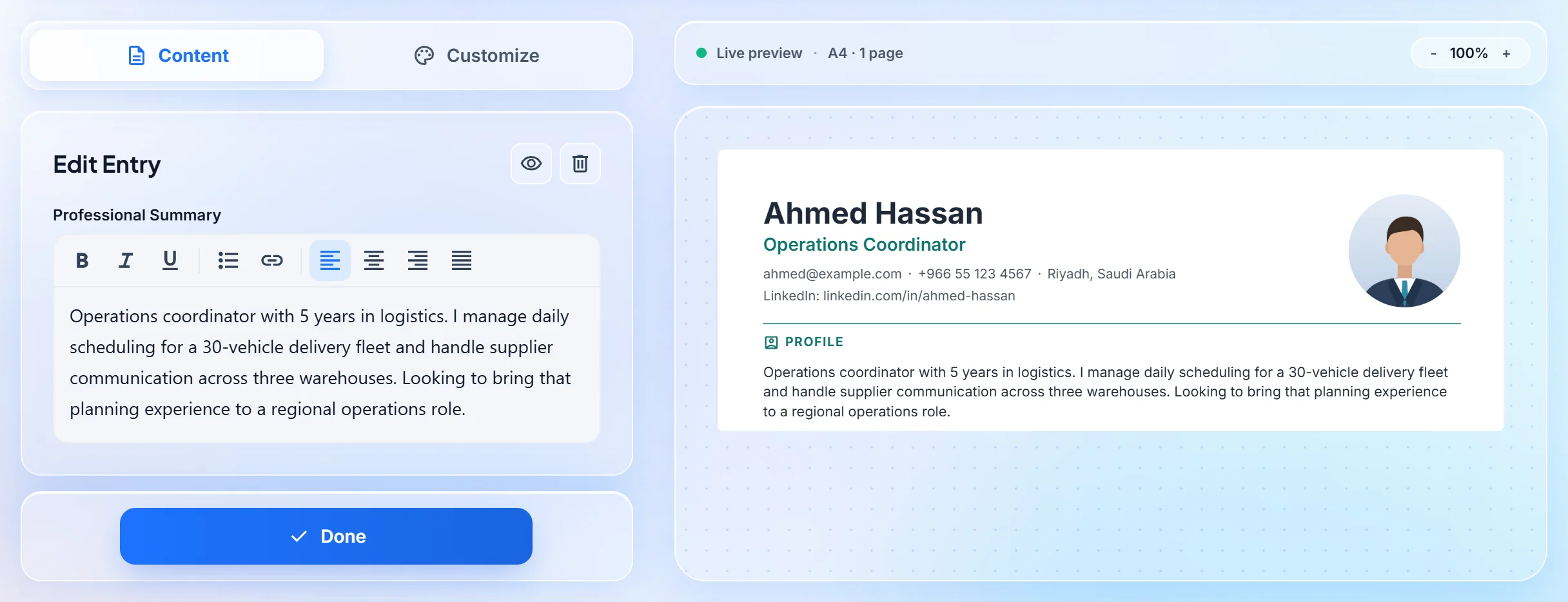
Operations coordinator with 5 years in logistics. I manage daily scheduling for a 30-vehicle delivery fleet and handle supplier communication across three warehouses. Looking to bring that planning experience to a regional operations role.
Step 3: Write long, then cut
Your first draft will probably be five or six lines. Cut it down by asking of each phrase: would the reader miss this? Remove words like "very," "highly" and "various," and merge sentences that repeat the same idea. Three to four lines on the page, or roughly 40 to 80 words, is a comfortable target.
Step 4: Tailor the last line
The first lines describe you and rarely change. The last line is where you name the role, the industry or the kind of company. Changing just that line for each application takes a minute and makes the whole CV feel written for that job.
Before and after: fixing weak summaries
Most weak summaries fail in the same few ways. Here's how to rewrite them.
| Weak version | Problem | Stronger version |
|---|---|---|
| Hardworking team player seeking a challenging position in a dynamic company. | Says nothing specific; anyone could write it | Customer support agent with 3 years in e-commerce, handling chat and email in English and Arabic. Looking for a team lead role. |
| I have worked in many roles in sales, marketing and admin. | Too broad; the reader can't place you | Sales coordinator with 4 years of B2B experience, preparing quotes and following up on a pipeline of about 60 accounts. |
| Results-driven professional with a proven track record of success. | Claims results without showing any | Accountant who closes monthly books for 3 branches and built the expense report template the finance team now uses. |
| Recent graduate looking for an opportunity to learn and grow. | Only talks about what you want | Business graduate with a 3-month internship in market research and strong Excel skills, applying for junior analyst roles. |
The pattern is always the same: replace adjectives with facts, and replace general wishes with a named role.
CV summary examples by situation
All names and details below are placeholders. Copy the structure, not the facts.
Experienced professional
Project manager with 9 years of experience delivering construction and fit-out projects for commercial clients. I've led teams of up to 25 across design, procurement and site work, and I'm known for keeping budgets and schedules visible to every stakeholder. Looking to manage larger mixed-use projects.
Mid-level specialist
Front-end developer with 4 years of experience building web apps in Vue and TypeScript. I focus on accessible, fast interfaces and work closely with designers to ship features end to end. Interested in product teams that care about performance and usability.
Recent graduate
Computer engineering graduate with hands-on experience from a final-year project on IoT sensors and a summer internship in network support. Comfortable with Python, Linux and basic networking. Applying for junior IT support and systems roles.
If you're just starting out, your summary leans on education, projects and internships, and that's fine.
Career changer
Secondary school teacher with 6 years of experience designing lessons and assessments, now moving into instructional design. I recently completed a course in e-learning development and built two sample training modules. Looking for a junior instructional designer role in corporate learning.
The trick is to name the old field once, then point every other phrase at the new one.
Returning after a break
HR generalist with 5 years of experience in recruitment and onboarding, returning to work after a two-year career break. I've refreshed my knowledge of HR systems through a recent online course and I'm ready for a full-time HR role.
Address the gap briefly and move on. You don't have to explain it in detail on the CV.
Writing style: person, tense and tone
Person. CV summaries are often written in implied first person: you drop "I" and start with the noun ("Project manager with..."). Full first person ("I manage...") is also fine. Avoid third person ("Sara is a..."), which reads like someone else wrote it, and keep one style throughout.
Tense. Use the present tense for what you do now and the past tense for finished results.
Tone. Write it like you'd introduce yourself to a senior colleague: confident, plain and specific. Cut phrases that sound impressive but say nothing:
- "Proven track record" → name the result
- "Excellent communication skills" → say who you communicate with and how
- "Passionate about..." → show the passion through a project or a choice you made
- "Seeking a challenging role" → name the role
Make the summary and the rest of the CV agree
Every claim in your summary should be backed up lower on the page. If you say you manage supplier communication, at least one experience bullet should show it. If you mention a tool, it should appear in your skills section too. Our guide to skills for your CV covers how to choose and word those skills, and the step-by-step guide on how to make a CV covers the experience bullets.
Your summary is also a good base for interviews. The classic opening question is close to a spoken version of it, so see how to answer "Tell me about yourself" once your summary is written.
Adding your summary in DraftPik
In the DraftPik resume generator, the summary is one of the default sections in the Content tab:
- Open the summary section and type into the Professional Summary field. The formatting toolbar lets you add bold, italics, a bullet list or a link, but a plain paragraph is usually the cleanest choice.
- The section heading is Profile by default. Use Edit Heading if you prefer Summary or Professional Summary.
- In the Customize tab, the Sections panel has options for the summary, such as showing it as part of the header and choosing whether its heading is shown.
- Watch the live preview. If the summary pushes your CV onto a second page by a line or two, trim it before you cut anything from your experience.
Your content stays when you switch templates, so you can check how the summary looks in a one-column and a two-column design without retyping it.
FAQ
How long should a CV summary be?
Three to four lines on the page is a good target, which is usually 40 to 80 words. If it runs longer than five lines, it's probably repeating your experience section.
What's the difference between a CV summary and an objective?
A summary leads with what you offer: experience, skills and results. An objective leads with what you want. Most people do best with a summary that ends in one line about direction, which gives you the benefits of both.
Should I write my summary in the first person?
You can write "I manage..." or drop the pronoun and start with your title. Both are common. Avoid writing about yourself in the third person, and keep the same style throughout.
Ready to write yours? Open the free resume generator, paste your draft into the Professional Summary field and adjust it while you watch the live preview. The Free plan includes one CV, and with a free account you can download it as a clean PDF, up to 10 downloads a day.